Showing posts with label Travels in Korea. Show all posts

Monday, April 1, 2013

My South Korea Top Ten Gratitude List

While in South Korea for my graduation, I was glad to have time to spend with people who had helped me while I was there and to say goodbye. I also tried to enjoy doing things that I liked as a way of saying goodbye to the country where I had spent much of the past four and half years. As I travelled to Seoul and back and spent time visiting the city, I thought about the many things I appreciated about South Korea.

Below is a list of the ten things I most appreciate about South Korea at this point in time (in no particular order):

1. Noraebangs (Singing rooms): I love singing, but was always intimidated by singing Karaoke at a bar. The music tracks at Noraebangs are much easier to sing along to and the small rooms provide enough intimacy to make almost anyone comfortable with giving singing a go. And you can sing whatever you want (I think so anyway). Picture me singing "You spin me right round, baby right round" by myself on my birthday. If this makes you sad for me, don't be. I was having the time of my life! :)


2. Saunas/spas: There's something great about being able to shower, bathe, go in different saunas, sleep and relax all you want all for about $10. My favorite spa is one in Seoul called Spa Lei. It's a women's-only spa, with wonderful white robes instead of the short sets you get at other Korean saunas.

3. Fast service and delicious and healthy food: I keep looking for the button to push on the table when I'm at a restaurant. I was shy to use this at first in Korea (it's like a doorbell that customers use to call the servers), but I really miss it now. Nothing like asking for and getting what you want quickly and efficiently, with hardly any lines or waiting. I have to remind myself to be patient again when I am waiting in lines in Canada.

I also gained an appreciation for "food as medicine" in Korea. I wasn't always able to practice this in Korea as much as I wanted to, but I have definitely made a commitment to eating more healthy food now that I am home and I'm not necessarily being pressured to eat something. I am a much better eater after going to Korea. My mom would be proud.

I recently read a book called the "5-Factor World Diet" and South Korea was included in it as one of the countries' traditional diets from whom we in North America could learn a lot. The picture below shows banchan (side dishes, like tapas, that are usually served before a meal). According to the book, eating side dishes like these helps to slow down eating and reduce portion size, particularly when you're using chopsticks (although I never really saw anyone eating slowly or in a small way in Korea...there's the food--go! ;). Also these side dishes help to ensure that there is a variety of tastes, including sweet, sour, bitter, salty, and spicy (the five-flavor approach often used in Chinese, Japanese, and Korean cooking). The picture above is of a savory pancake-like dish made with buckwheat and scallions. The red fermented dish is kimchi and the other side dishes are mushrooms, black soy beans, some soy sauce for the pancake, and some kind of seaweed (I still don't eat seaweed yet so I'm not familiar with the different kinds).


4. Eclecticism: There's a great mix of old and new, of history and modernity, of different styles and ideas being tried on. When people try something on in South Korea, they really try it on. I admired this passion. I guess this is true of many places around the world, but it seemed like there was a focus on promoting old and new and everything mixed in between and that really struck me.


5. Healthy skin and a sense of style and focus on appearance: There are drawbacks to this, of course, like not feeling like you can go out when your hair is all messed up and you are wearing your oldest and most comfy sweatpants. But, there was something about people's concern for their appearance and health that I liked. It made me take care of myself better.

6. Broadband speed and Wifi: Everywhere you go you can access wifi, even in the subway, and...it's fast (like most things in Korea).

7. Safety: I rarely felt unsafe. Maybe this is because there are usually so many people everywhere you go. Also, I could easily tell where and when it was safe to walk by myself. My laptop was stolen from my one-room apartment, and then safely returned in the wee hours of the next morning (through the gaps in the bars of my window while I was sleeping--see picture below). I'm not sure why it was returned--maybe because it had an English O/S and couldn't be sold on the black market? But, regardless, I was happy to have my laptop with all of my PhD data and research on it back. Some people also suggested it spoke to the "honesty" of the thief who stole it.


8. The sea and the mountains: Love having both so close to each other.


9. Public transportation: Reasonable, clean, and efficient. I especially loved the Express Buses, taxis (the ones with the friendly drivers), and subway system in Seoul. Having travelled back and forth from Cheonan to Seoul often, I spent a lot of time on them and really miss this level of efficiency and how reasonable public transit was there.

10. The smiles and passion: This helped me somehow feel at home in South Korea. There's always something happening and people doing it with passion and an openness to trying new things and to change. I appreciated all of the smiles I received and people's intent to connect, which I could sense, even though they might have been too scared to actually talk to me because they thought I was going to speak to them in English.


Goodbye and thank-you, South Korea, and all those I met and who touched my life. Until we meet again! :)

Sunday, February 5, 2012

Marek in Korea

In December, my husband Marek visited Korea. How lucky am I? It was great to spend time with him, especially over Christmas, and to be able to introduce him to people and travel around a bit. I appreciate all of the family and friends in Canada and here in Korea who helped to make his visit possible.


Tuesday, August 30, 2011

Beautiful Busan

Busan is the second biggest city in South Korea. It's a port city on the south-east coast. Ever since I came to Korea, I've wanted to visit Busan because I love the sea. Finally, this past weekend, my roommate and I made it for one night and one day (1N1D).

I was really glad we did. There's a different feel to Busan than Seoul--it's more relaxed and open, which makes sense since Seoul is a capital city. People were more talkative and even the foreigners I saw seemed to be more relaxed and comfortable than in other cities in Korea.

My roommate and I had a tight schedule and budget but we managed to fit a lot in. Busan is a 5-hour by slow-train, 2 1/2 hours by rapid train ride from Seoul.

We arrived late at night and stayed in this jjimjilbang on Gwangalli Beach. It was called Aqua Palace.


A jjimjilbang is a Korean sauna with showers and public baths separate for men and women. There's also a "resting" public area, where you can sleep. If you are okay with sleeping on a hard floor in a room with lots of people with snoring, talking, cellphones ringing, etc., it's a cheap place to stay and you can have a relaxing shower and bath.

This jjimjilbang was nothing fancy but it had a great view of the beach and the sea from the bath and resting areas.


The next morning we headed out and saw Gwangalli Beach by day. This is the view from the beach.


After that, we visited the "World's Biggest Department Store", the Shinsegae Department Store. It has an ice rink, a spa, a golf course, a roof-top park, and boasts the largest amount of retail space in the world.


We then visited one of only a few of Korea's Buddhist temples on the sea. This one is called Yonggunsa. Isn't the view beautiful?


After that we stopped off at the famous Haeundae Beach. We dipped our feet in the water where there were lots of people bobbing in floating tubes. The sand has lots of crushed shells and stuck to our feet. In the busy season, this beach is normally packed full of umbrellas so even though there were lots of people it wasn't considered to be crowded at all.


We ended off the day by going to the Jagalchi Fish Market. We saw lots of interesting live and dried fish, including these octopus below. There are lots of restaurants, too, where you can choose the fish or seafood you like and have it cooked right in front of you.


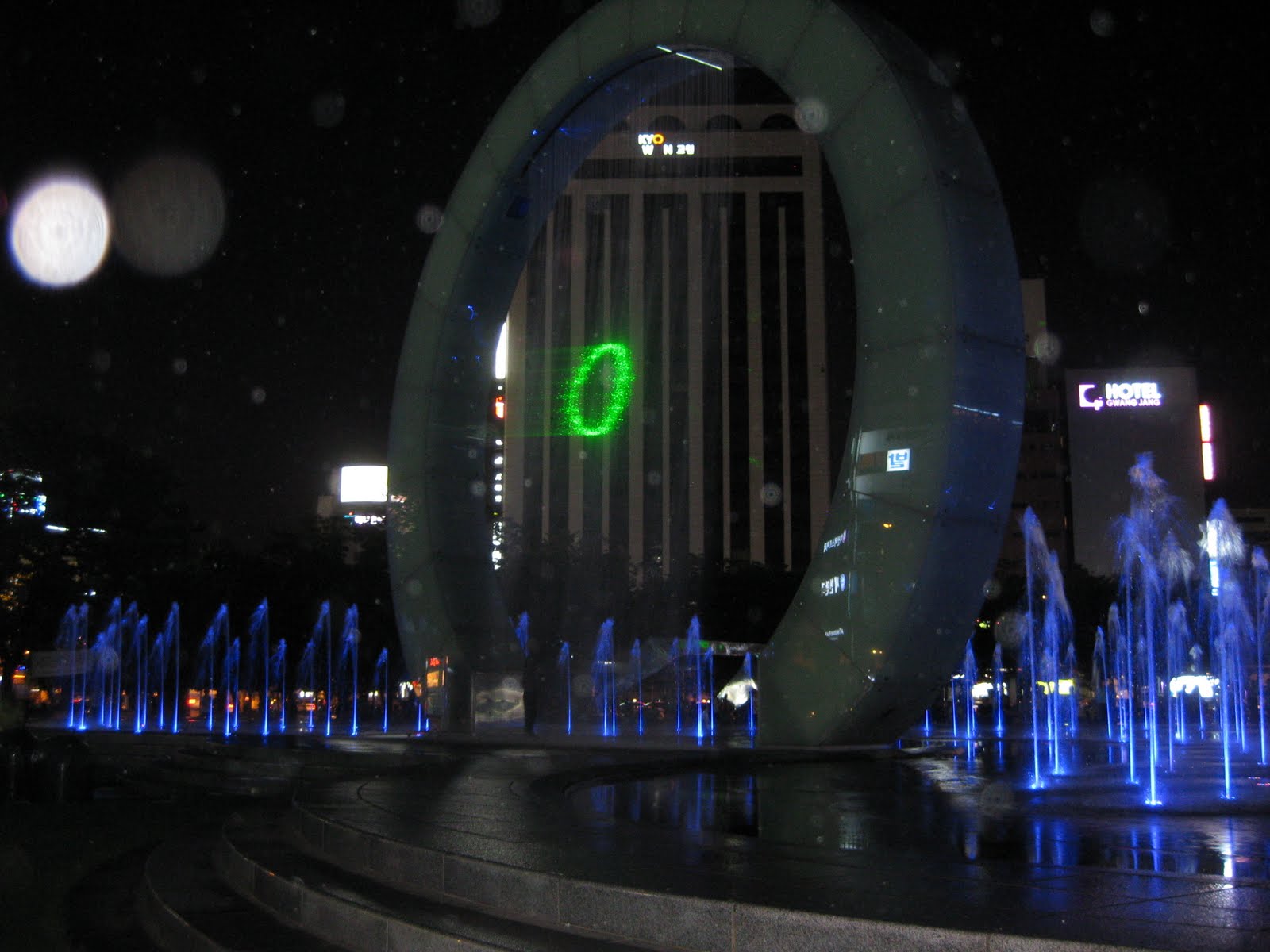
While waiting for our train back to Cheonan, we were treated to a light, music, and water show at the fountain in front of the train station. I think this might be common in Korea in big cities (I've seen a small one in the stream in downtown Cheonan behind our apartment building) but this one lasted for about 40 minutes and lots of people gathered to watch.


When I first arrived in Korea, someone asked me if I liked the mountains or the sea. My first thought was to say, "Both", but my answer came quicker than my thinking, "The sea". I like the mountains, too, but there's something about water that makes me feel relaxed, happy, and more connected with nature, with other people, and with myself. I'm glad I had the chance to visit Busan and if I get the chance, I'll definitely be back.

Monday, April 18, 2011

Time for the TOPIK Again...This time it's Spring at Kyung Hee University

Yesterday, I took the Intermediate Level of the TOPIK (Test of Proficiency in Korean). Last November, I passed Level 2 of the Basic Level and this time, my goal was to pass Level 4. (I need to pass Level 5 eventually as a requirement for my Ph.D. degree). In the past month, I realized this goal was probably not realistic. When I was doing the practice tests, I realized that despite all the studying I had done, there was a lot of grammar and vocabulary I still didn't know and although I had been studying it for a while now, still not enough time to learn it.

Taking the test was proof of this. A lot of the questions seemed to include the vocabulary and grammar I didn't know well. I was slowed down by this and rushed to finish the Writing section and didn't get to finish the last five or six questions of the Reading section, so had to guess. I also realized that I had never practiced doing the tests within the required time limit because I had been so focused on trying to learn the unfamiliar vocabulary and grammar in the practice tests. Once I learn the Intermediate-level vocabulary and grammar better, I will need to do this.

My hope is that I at least passed Level 3. If not, at least I will know what level I am at and what I'll need to do to pass Level 4. I've said it before...learning Korean is very good training for me.

In Seoul, the TOPIK is held at Kyung Hee University. The university grounds are beautiful as it is, but it being Springtime, all the trees were in full bloom.


Wednesday, February 2, 2011

English Meeting in the Mountains

Last weekend, some of the students from our Brain Education English group at UBE spent the weekend in the mountains.

We met in the town of Mungyeong and from there went to the Mungyeong Saejae Provincial Park and hiked to a cabin in the mountains. That night, we enjoyed good food, music, and conversation with our host, the owner of the cabin (first picture).


The next morning we walked to the nearby falls.


After lunch, we walked to the First Gate and then Second Gates (built after the Japanese invasion of Korea in 1592 and 1598), of a mountain pass that had once been the main route for scholars travelling from Busan to Seoul for the public officials exam during the early Joseon Dynasty (in the 1400s). Along the way, we saw rest stops that were used by the officials and one of the filming sites used by the Korean Broadcasting System for historical dramas. We also visited the Mungyeong Saejae museum.


On Saturday night, we visited the home of a well-known potter who makes traditional tea bowls. Each bowl is unique, has a name, and a story. We each chose a bowl, heard the name and story of the bowl and then watched the tea-making ceremony and drank the fresh ground tea, which was similar to green tea. That evening we slept at the sauna at the Mungyeong Hot Springs and in the morning bathed in the hot spring water.

The next morning we had our English meeting about one of the tools used in Brain Education, called PDCA (Plan, Do, Check, Action)--a tool that is helpful for planning, evaluating and achieving goals.

For more information about PDCA, click here. Click on the PDCA tag, for a series of articles about PDCA and ideas for applying it to your life.

Many thanks go to fellow students--Hee Jeong Kim and his friend for organizing our accomodations and our weekend activities and the other Hee Jeong Kim and her lovely daughter Kum Kang for participating.

Sunday, August 1, 2010

Poongrudo Training


Last month, I took part in a Poongrudo training in Seoul.

Poongrudo is a kind of advanced Brain Education training based on the traditional music, dance, and singing culture that has been part of Korea's history for thousands of years. There are currently 9 Poongrudo centers in Korea. It is meant to be a joyful practice that combines movement, dance, singing, and playing instruments as a way to awaken the brain and body, increase mental and emotional flexibility and control, and to integrate the different functions of the brain.

Our training started with a visit to the Changdeok Palace. The Changdeok Palace is from the Joseon Dynasty and one of the Seoul royal palaces on the UNESCO World Heritage List. During the Joseon dynasty, neo-Confucianism was the ruling ideology, so ritual propreity, virtue and frugality are reflected in the dignified and restrained architecture of the palace. The palace was used as a living place for Queen widows and consorts of the King.


After a visit to the palace and dinner, we enjoyed Brain Wave Vibration training at the Seoul Poongrudo Center with Sun Poong nim, professor of Poongrudo at UBE and the person in charge of Poongrudo in Korea. I had experienced training with him when I took his class here at UBE before so it was great to experience it again. Sun Poong nim played the jang-gu (a traditional drum) and flute and sang. Through movement, tapping, and vocalization, we could release tension from our bodies and enjoy the flow of the music.

Afterwards, we enjoyed delicious food together and singing and dancing to traditional songs. The songs, all of which follow the 3-beat pattern matching the Heaven-Earth-Human (Chun-Ji-In in Korean) worldview, were sung in partners by all of the participants.

The next day, we hiked up Mt. Bukhak, which is also the location of part of the Fortress Wall of Seoul (which connects four mountains in Seoul) and close to the current site of the "Blue House", the executive office and official residence of Korea's president.


At the top, we had a Chun Je Ceremony, which means a Ceremony to the Heavens. This is also a practice that is part of the traditional culture of the Korean people. Food and drink are prepared and a ceremony is held to "the heaven". In Korea, mountains and particularly, the tops of mountains are considered to be very sacred places. Afterwards, we enjoyed the food together.

Sunday, January 24, 2010

The National Assembly and National Assembly Library in Seoul

Last year I visited the National Assembly Library in Seoul to find some theses and articles related to Brain Education.

The National Assembly Library serves as a parliamentary library for the members of the National Assembly and legislative support groups and has been open to the general public since 1998.


The National Assembly Building is the building that serves as the location of the National Assembly of the Republic of Korea. The building was completed in 1975. Before that, it was located in the Japanese General Government Building built by the Japanese during the period of colonial rule. Elections for the National Assembly were first held under UN supervision on May 10th, 1948 and the First Republic of South Korea was established on July 17th, 1948 when the constitution of the First Republic was established by the Assembly.


For those interested in history, the National Assembly website has a basic video about Korean history. It shows the long history of the Korean people, the extent of land and influence they had, and the way they were influenced by other nations, all of which have had a great impact on the Korean people today.

National Assembly Website

A personal note: As of this posting, I finally figured out how to create a direct link to other websites--so exciting (for me)! I apologize for all the times I gave the instruction to cut and paste the links into your browser and now that I've entered the 21st century, I promise you you won't have to do that again. Sorry for the inconvenience. I am proof that you can change your brain!

Monday, January 12, 2009

Hallyeo National Marine Park

One of my fellow colleagues and students, Park Jin-Kyu and I took a bus trip from Seoul to Tongyeong in the South of Korea. Because it's off-season, for about $30, our trip included breakfast and lunch on the bus (rice and kimchi), and a fish dinner at the sea port of Tongyeong.

The great think about South Korea is that you can easily travel from one end of the country to the other in a day. We left Seoul, which is in the North, at 8 in the morning and were back by 9 in the evening.

In Tongyeong, we took a cable car to the top of Mt. Mireuk and from there, saw amazing views of the Hallyeo National Marine Park. While at the top, we also saw and heard two blackbirds, which Park Jin-Kyu nim said was unusual by the sea and a sign of good fortune.

Monday, December 29, 2008

Andong--Home of Confucianism in Korea

Andong is a city on the Nakdong River in the Eastern part of South Korea. During the Joseon Dynasty (1392-1910), Andong attracted scores of Confucian scholars, becoming a pioneering city in Confucian thought. This city also contained the highest number of private and Confucian schools during that time. To this day, Andong still has around 26 private schools from the Joseon Dynasty period. The city also acted as a home to the noble class during the Joseon period. Queen Elizabeth visited the city in 1999.

Confucianism was introduced to Korea by a Chinese scholar. Although often considered a religion, it is more accurately described as a detailed code for interpersonal behaviour, a practical social and political doctrine. A system of education, ceremony, and administration were developed based on Confucian teachings.

It is easy to see the influence of Confucianism on Koreans today. Respect for elders, even when there are slight differences in age, and loyalty to one's kin and authority figures when required is considered to be very important.

In Andong, we visited the Korea Studies Advancement Center--a large complex with a museum devoted to preserving and transmitting Confucianism. Due to the strong history of Confucianism in this area and the way history has been taught in schools throughout Korea, many people are not aware that Confucianism, like Buddhism and Christianity, was introduced to Korea and that it is not the root of Korean culture.

After taking a training offered through our Korean Traditional Cultural Institute (Kookhakwon), an Andong city councillor realized the error that had been made in the naming of the Korean Studies Advancement Center in his city. He, along with the Mayor of Andong and other city officials and scholars, attended the event hosted by Kookhakwon in Andong this weekend and are interested in correcting the error that was made and in bringing Brain Education and training about the root of Korean culture to their city.


At a lecture sponsored by Kookhakwon, Dr. Lee, who studies the ancient Korean culture of Hanminjok, discusses the three elements of traditional Korean culture: Heaven, Earth, and Human, as distinct from the two traditional Chinese elements of yin and yang.